Table of Contents
- Summary
- Introduction: Why Japan Is Different from China and Southeast Asia
- What Is ChargeSPOT?
- Why Japan Became a High-Value Power Bank Rental Market
- ChargeSPOT Business Model Explained
- Japan vs China: Pricing, Venue, User Behavior and Operations
- What Operators Can Learn from ChargeSPOT
- Why Localization Matters More Than Hardware
- Can This Model Work in Southeast Asia?
- Lessons for POS Companies, Payment Companies and Franchise Operators
- How JUUGO Supports Operators Building Similar Networks
- Frequently Asked Questions
This article covers: Why Japan's shared power bank market generates higher revenue per unit than other markets, how ChargeSPOT built a successful network through deep localization, key differences between Japan and China market dynamics, and practical lessons for operators planning deployments in Southeast Asia and other global markets. Includes a Japan vs China comparison table and 8 lessons for overseas operators.
Data Verification Note
Financial data, IPO information, market capitalization, and specific company metrics mentioned in this article should be verified with official filings or trusted financial news sources before publication. JUUGO provides this analysis for educational purposes based on publicly available industry information.
Introduction: Why Japan Is Different from China and Southeast Asia
Japan represents a unique market for shared power bank rental business — one where pricing, user behavior, and operational requirements differ significantly from both China and Southeast Asia.
Understanding why Japan developed into a high-value market helps operators appreciate the importance of market-specific strategy over generic deployment approaches.
This article examines the Japanese market through the lens of ChargeSPOT, a company that achieved notable presence in Japan's power bank infrastructure, and extracts actionable lessons for operators considering Southeast Asian or other global markets.
Key insight: Market value is not determined by population size or smartphone penetration — it results from the intersection of user payment behavior, venue density, pricing flexibility, and operational infrastructure.
What Is ChargeSPOT?
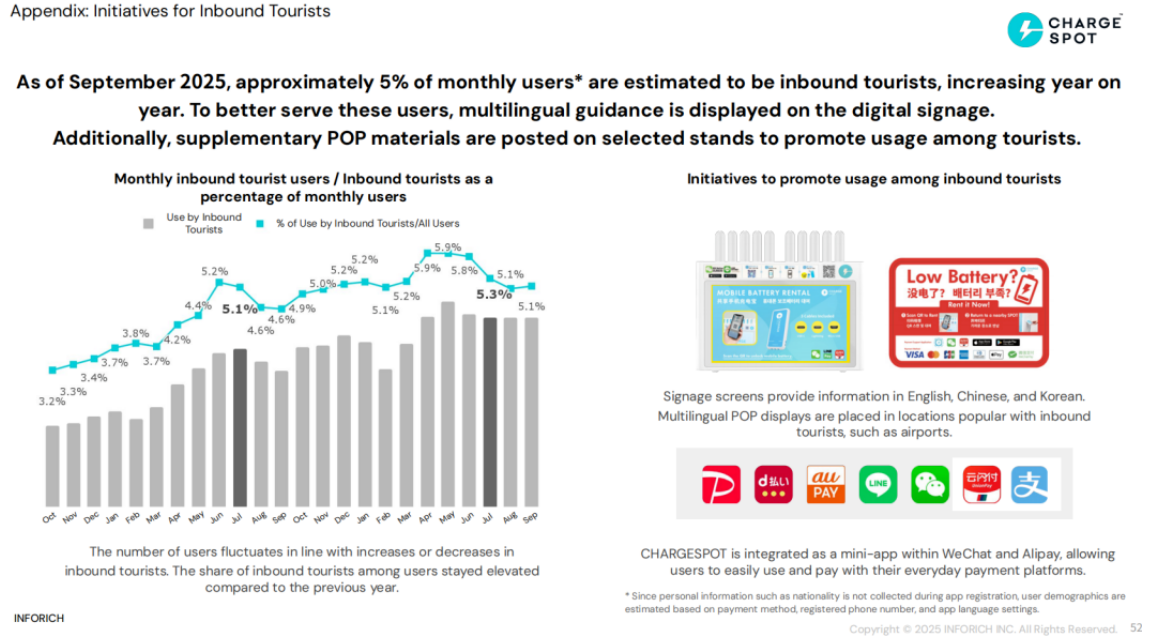
ChargeSPOT is a shared power bank rental service that operates across Japan, Taiwan, Hong Kong, and Thailand. The company is associated with INFORICH, a Japanese technology company, and has expanded internationally from its Japanese operational base.
The company gained attention for its Japan market operations where it deployed power bank kiosks in high-traffic locations including convenience stores, transit stations, and commercial complexes.
ChargeSPOT has been cited in industry discussions regarding international expansion strategies for shared power bank businesses, particularly its approach to market entry and localization in the Japanese context.
Why Japan Became a High-Value Power Bank Rental Market
Several structural factors contribute to Japan's distinct characteristics as a power bank market:
- High smartphone dependency: Japanese consumers rely heavily on smartphones for navigation, payment, and communication, making battery depletion a significant friction point
- Cash-dominant culture transitioning: While Japan has traditionally been cash-focused, digital payment adoption accelerated, creating infrastructure for electronic transactions
- Convenience store density: Japan has the highest convenience store density globally, providing natural locations for service points
- Transit-oriented urban design: Major cities are designed around transit hubs, creating predictable high-foot-traffic corridors
- Quality expectations: Japanese consumers expect high product quality and reliable service, which shapes operational standards
For China shared power bank market analysis, the differences in market maturity and user behavior are substantial, highlighting why copying China strategies directly does not work in Japan.
ChargeSPOT Business Model Explained
ChargeSPOT's approach in Japan incorporated several market-specific elements:
Japan Market Localization Elements
- Hardware specifications: Equipment designed for Japanese safety standards and environmental conditions
- Payment integration: Support for Japanese payment methods including transit cards and local e-wallets
- Venue partnerships: Strategic placements in convenience stores (7-Eleven, Lawson, FamilyMart) and transit stations
- Pricing strategy: Premium pricing reflecting Japanese consumer willingness to pay for convenience
- Operational standards: High maintenance and restocking frequency meeting Japanese service expectations
The company also pursued international expansion, bringing its operational model and technology to other Asian markets including Southeast Asia.
Japan vs China: Pricing, Venue, User Behavior and Operations
| Factor | Japan Market | China Market | Operator Implication |
|---|---|---|---|
| Pricing | Premium pricing (¥400-600 per day equivalent); higher willingness to pay | Lower pricing (¥2-6 per hour); volume-driven model | Revenue per unit higher in Japan; requires different ROI expectations |
| Venue Cost | Moderate; convenience stores provide relatively accessible locations | High competition; premium venues monopolized by major brands | Japan offers more accessible venue partnerships for new entrants |
| User Payment Behavior | High credit card adoption; transit card integration valuable | Dominant mobile payment (Alipay, WeChat Pay); super-app integration | Different payment integration priorities by market |
| Density Requirement | Lower density acceptable due to transit-centric usage | High density required for habit formation and convenience | Japan deployment can start smaller; China requires network scale |
| Merchant Relationship | Formal, contract-based partnerships with clear terms | Variable; from formal chains to informal small merchants | Japan requires more structured business agreements |
| Operating Cost | Higher labor and logistics costs; premium service expectations | Lower operating costs; higher device density offsetting margins | Japan operations require higher margin per transaction |
| Payment Integration | Transit cards (Suica, PASMO), credit cards, PayPay, LINE Pay | WeChat Pay, Alipay, UnionPay; super-app ecosystem | Cannot copy payment strategy between markets |
| Brand Trust | High brand sensitivity; established brands preferred | Function-first; price and convenience drive adoption | Japan requires brand-building investment |
What Operators Can Learn from ChargeSPOT
While direct comparisons between markets have limitations, several strategic lessons emerge from the Japan market approach:
Lesson 1: Deep Localization Over Copy-Paste
Successful Japan operations required more than translating Chinese content — they needed market-specific hardware, payment integration, and operational standards.
Lesson 2: Pricing Strategy Must Match Market Reality
Japan pricing that appeared high by China standards was actually appropriate for local consumer expectations and operational costs.
Lesson 3: Venue Partnerships Require Different Approaches
Japanese convenience store chains operate differently from Chinese venue partners, requiring distinct negotiation and operational frameworks.
Lesson 4: Operational Standards Are Non-Negotiable
Japanese consumers expect consistent service quality. Device downtime or empty kiosks generate negative impressions that damage brand adoption.
Why Localization Matters More Than Hardware
The shared power bank business is fundamentally a service business, not a hardware business. This distinction becomes clear when comparing market outcomes:
Why Hardware Quality Is Necessary But Not Sufficient
- Payment experience: Users judge the service by payment completion, not device aesthetics
- Return convenience: The ability to return power banks at any location affects usage frequency
- Customer support: Responsive support in local language builds trust
- Settlement transparency: Merchants expect clear, timely revenue sharing
- Data visibility: Operators need real-time insights for optimization
For how to choose a power bank franchise supplier, operators should prioritize vendors who offer complete market-ready solutions over those selling hardware alone.
Can This Model Work in Southeast Asia?
Southeast Asian markets share some characteristics with Japan while having distinct features of their own:
- Thailand: Strong mobile payment adoption (PromptPay), tourist-heavy locations, mall culture
- Vietnam: Cash-dominant but mobile growing rapidly, localized payment preferences
- Malaysia: Multi-ethnic market with distinct payment preferences (TNG, Boost, GrabPay)
- Indonesia: Large population, emerging middle class, Grab and GoPay dominance
- Philippines: Remittance-driven economy, GCash and Maya adoption growing
For Malaysia shared power bank failure case, the lesson is clear: market-specific localization is essential regardless of how successful a model appears elsewhere.
Lessons for POS Companies, Payment Companies and Franchise Operators
8 Lessons for Overseas Operators
- Do not copy China pricing directly: Each market has different cost structures and consumer expectations
- Build localized payment experience: Local e-wallets and payment methods must be integrated, not just international options
- Use data to adjust pricing: Start with market-appropriate pricing and adjust based on transaction data
- Choose dense but high-quality venues: Location quality affects both usage frequency and brand perception
- Build merchant trust: Clear settlement terms and reliable payments maintain venue partnerships
- Control hardware quality: Device reliability affects both user experience and maintenance costs
- Operate with a SaaS backend: Real-time monitoring and data analytics enable operational optimization
- Treat payment and settlement as core infrastructure: Unlike hardware, payment systems are difficult to retrofit after deployment
How JUUGO Supports Operators Building Similar Networks
JUUGO provides a complete shared power bank business solution designed for Southeast Asian and global market requirements:
JUUGO's Market-Ready Approach
- Pre-integrated payment methods: Local e-wallets, QR payments, and transit card support by market
- SaaS platform with dashboard: Real-time monitoring, maintenance alerts, and revenue analytics
- Hardware designed for overseas: Equipment specifications matching regional requirements
- Merchant settlement system: Configurable split ratios with transparent reporting
- Pilot deployment support: Market validation before full-scale investment
- Operations playbooks: Proven operational frameworks adapted for local markets
Frequently Asked Questions
Q: What is ChargeSPOT?
ChargeSPOT is a shared power bank rental service that operates across Japan and several other Asian markets. The company gained recognition for its market presence in Japan and its international expansion strategy, particularly through partnerships with convenience store chains and transit operators.
Q: Why is Japan attractive for shared power bank business?
Japan offers several attractive characteristics: high smartphone dependency creating battery anxiety, premium pricing acceptability, convenience store density providing accessible locations, transit-oriented urban design creating predictable foot traffic, and high service expectations that support quality operators.
Q: Is power bank rental profitable in Japan?
Japan market characteristics — including higher pricing tolerance and accessible venue partnerships — suggest better unit economics compared to highly competitive markets. However, specific profitability depends on operational efficiency, device reliability, and management of operating costs.
Q: What can Southeast Asia operators learn from ChargeSPOT?
Key lessons include: localization is more important than hardware quality alone, pricing must match market expectations, payment integration must prioritize local methods, and operational standards affect brand adoption. Southeast Asia markets require their own localization approaches rather than direct replication of Japan strategies.
Q: What payment systems are needed for Japan power bank rental?
Important payment integrations for Japan include transit cards (Suica, PASMO), credit cards (Visa, Mastercard, JCB), and e-wallets (PayPay, LINE Pay). International QR codes have limited adoption in Japan compared to other Asian markets.
Q: Can JUUGO help build a ChargeSPOT-like power bank network?
JUUGO provides the complete system — hardware, software, payment integration, and operational support — needed to build a professional power bank rental network. Contact JUUGO to discuss market-specific deployment plans for Japan, Southeast Asia, or other global markets.
Related Articles
- China Shared Power Bank Market 2026: 3M Devices, Market Lessons & Global Opportunities
- Power Bank Rental Business ROI: Profit, Cost Breakdown & 6 Revenue Streams
- How to Start a Shared Power Bank Business in 2026: Complete Guide
- Why Shared Power Bank Businesses Fail in Southeast Asia: Malaysia Case Study
Key Takeaways
The Japan market demonstrates that shared power bank business success requires market-specific strategy rather than copying approaches from other regions.
Localization of payment methods, pricing strategy, operational standards, and venue partnerships determines outcomes more than hardware quality or deployment scale alone.